
 Just jet-skiing around Lady Liberty.

23 Tuesday Oct 2012
Just jet-skiing around Lady Liberty.
16 Tuesday Oct 2012
Take a look around a medical school around this time of year and you’ll see two very different groups of people.
The first group seems delighted to be there- happy, motivated, driven, “gunning it”, ready to go out there and save the world. For the most part, they enjoy the rigors of medical school. They’re the people with perky looks, dressed nicely, smiling and being pleasant.
Then, there’s a second group. The second group has bags under their eyes. They’re tired, cranky, a little depressed, constantly cursing at being in medical school. They walk with their heads down, their eyes seem sunken and their clothes are most often sweatpants and T-shirts. There may be coffee stains on their clothes, and as they pass out in a mound of books- drool coming out of a corner of their mouths.
The first batch, as any medical student could tell you, are first years. The second batch are second years.
First year of medical school as you walk in the door, you’re excited, driven, motivated. You’re in med school! You “gun” everything- studying for hours upon hours till exhaustion, and then once the test is done partying and drinking to oblivion. You’re excited about almost everything, you’re brand new and you want to learn- and by golly you show it!
Second years, by contrast have been through the cycle. Having been forcefed vast tracts of information every 6 weeks (on average, 120 hours of lecture total) full of arcane facts that aren’t clinically relevant and despite the school (and the block’s) stated policies of testing “big picture” stuff will still be tested. So you prepare to be able to recite Bernoulli’s equation, the resistance of a vessel, the histology of polyarteritis nodosa, or some other information that in all likelihood is never tested. That’s okay you say, we all jump through hoops. Now do it again, and again, and again. Take a weekend- sometimes between the end of one and the start of the other. At the same time, realize that you’re actually supposed to be taking care of patients in a year- so try to learn to do that as well. Then, add in the required doctoring material- some exceptionally good, some mindblowingly boring. Plus minor things, like eating, cooking, working out, laundry, showers…
The thing you learn somewhere halfway through first year is that medical school is a collection of 200ish of the smartest people you can imagine. We all went through college getting accolades, being told we were brilliant, seeing amazing grades and awesome results. Then, when you get to medical school you see the scariest thing of all. A passing score- or an average score. And then you realize that the thing you based your self worth on- your intelligence- no longer sets you apart from the herd. You’re somewhere smack in the middle. Truth be told, most people in med school are about as smart as one another. The difference is the hours people put in. Some, seeking to maintain that self worth, put in 15-18 hour days regularly- and cringe when they see a 94% on a test. Others, work hard but try to balance- and are happy with a mid 80’s grade. Still others realize the futility of the system and how irrelevant some of it is to clinical practice, and cherish having their lives- cheerfully taking the 70s-80s they get. None of those is “better” than the other- each seeks to maintain their self worth and sanity how they can.
But, if you’re in the second or third category- before too long, if you’re not careful you start completely losing your mind. So, how do you hold onto your sanity in this crazy pressure cooker of a system? Here’s my secret. I add in the things that make my life meaningful to me. (I never said it wasn’t an obvious secret…)
Most of us get addicted to something- I chose to get addicted to exercise rather than alcohol or other “helpers”. So, I work out. If I don’t, as I likely won’t be able to for much of this week, I feel the withdrawal. Medical school is such an isolating and lonely experience that I realized the value of the people in my life rather quickly. The value of a support system, people to talk to, go do things with, people to share the neurosis that medical school creates can’t be overstressed. It keeps most of my classmates holding onto the last shreds of their sanity. And for me, it lets me hold onto the last thread.
What else? I added on a masters program. Yes, I added more work to a medical school career. Clearly, I’ve gone around the bend and need to be committed. But, fact is- I was a philosophy major in college and I feel the need to think about the world we’re living in. I need to consider the why’s, the what for’s. If I don’t do that in a disciplined or a more direct way I end up asking myself the why and the what for about medical school- which is a terrible idea, trust me.
Also, I travel. I go where I can, when I can. More so, I do what I can.  I have a fear of heights, so I jumped out of an airplane. This weekend, I’m going jet skiing on the Hudson River with a friend after our exam. I’m travelling to London with the same friend for New Years. I’m meeting up with my family in Hong Kong (maybe- or we may go somewhere else) after I’m done with Step 1. I’m going to take a flying lesson or two in the next few weeks. Not to mention, scuba diving, skiing, snowboarding. Med school makes my days rather boring, bland, and frankly depressing. So, I choose to inject what enjoyment I can into it- as easily as I can.
Also, one of the biggest things I’ve learnt to do as I became a second year medical student is to clean up your baggage. In my experience, every person has people in their life who demand but don’t give. People who are either too hard to hold on to, or that one just can’t help. I’ve learnt to let go easier- so that I can spend more time with the people who are really important to me. It took a close friend passing to learn that lesson.
And the last way I cope? This blog. I like to write, and I enjoy dispensing my words of narcissism, questionable wisdom, and nonsense with reckless abandon!
If you’re in med school- relax. You’ll get through it- just realize that the system’s nuts, chuckle, bitch about it to the people who you trust and who’ll listen. And then keep going. What’s that famous quote? “If you find yourself in hell, keep going?”
If you’re going to med school- the one person who you shouldn’t be asking about med school’s value is the med student who’s $100,000+ in debt, has spent a year and a half buried in a mound of textbooks away from what they came to medical school to do- practice medicine. The same med student’s “paranoid, antisocial, and weird” (Erich Segal) and that’s what medical school turns you into. At the same time, as you walk out of a class and discuss something you covered over a year ago, subconsciously the right answer will push its way out. Perhaps madness is it’s method for medical school.
And if you’re sending your loved one to medical school- don’t stress. It’s hard work, but it’s doable. Just tell them to find what they have to do to get through it and proceed to do it. Preferably nothing illegal. A medical degree is of limited use if one’s license is then suspended for criminal charges…
19 Wednesday Sep 2012
Posted in Medicine
Tags
gaming, health, Medical School, medicine, mental-health, Travel, vacation
So, I’ve been tossing this around in my mind for awhile.
The first two years of medical school are packed. You’re going through material at a breathless pace, learning more than you ever thought you could remember and trying to package and digest that material at ever quickening rates. You begin to feel like a robot, learning about an alien race- with the Krebs cycle, Beta adrenergic receptors, P hormones that feels satisfied with fatty food.
As you wade through the lakes of material, knee deep with a quicksand like consistency you change. Who you are takes on a different meaning- you begin to define yourself more so by the amount of work you’ve done, the things you’ve learnt and the hours invested. The things that gave you pleasure BMS (before medical school) still do, but they’re guilty pleasures. You find yourself living more so in the seven deadly sins than ever.
From gluttony…

To lust… (yes, I’m a HIMYM fan- though a full season behind)

Either way, you find yourself suddenly feeling this sense of emptiness, this lack of meaning, the fleeting feeling that nothing really matters and life is meaningless. You find yourself asking if saving a person’s life from an MI or a PE or any other part of the alphabet soup of conditions really means anything. You ruminate on the purpose of life, on the why, the what for and the who cares. (Or maybe that’s just me)
You look at your life, filled with pathology, viruses, bacteria, anatomy, physiology and the like; devoid of most everything else. And then you realize how vast a gulf separates you from the rest of the world- the seeming naivete and rosy-eyed view they have is hidden from you.
So, how do you cope? Well you find and create meaning. You give your life purpose, add to it. Make it worth something to yourself and to others. Personally, I exercise- I run, I lift weights and I work up a good sweat. Some people turn to religion, I’m an atheist. So, I turn to yoga. I cook making the very act of making food cathartic and therapeutic. Doctor Who is my new guilty pleasure, letting me escape to worlds beyond this one- and the quintessential loneliness of his character resonates, I imagine, with each viewer. Most importantly, I enjoy the support of an amazing group of people. From my family, friends, acquaintances and more. I spend time with them all as often as I can- even if it’s remotely. I find writing handwritten letters to my grandfather to be a more candid way of communicating than when I’m sitting in the room with him sometimes. I make my own meaning.
For that’s my view of nihilism- at least in medical school. Nothing means anything. At least not on its own. We give it meaning by what we choose to value, what we choose to believe and what we choose to cherish. So give your life some meaning today, give it a purpose. Live vicariously, purposefully and powerfully.
And while you’re at it, make someone else’s life a little better too. That never hurts.
In case you’re wondering what brought on this philosophical reflection and random spewing of words- its a book (“Hannibal and Me”). I highly recommend it more so since it uses some of my favorite quotes of all time:
“If you can meet with triumph and disaster and treat those two impostors just the same”
14 Friday Sep 2012
Tags
Firstly, my apologies for the long silence. Microbiology as a block is quite high volume -capable of leaving one with little time for other things.
Now, a funny thing happened some days ago. As my roommate (also a second year medical student) and I left the house to go to the gym we saw someone lying on the side of the road next to a firehydrant. There were two women near him talking excitedly. My roommate, smart man that he is, asked “Was he shot?” Why does asking that question make a difference you ask? Because the first thing they teach you to do in an emergency situation is to make sure your scene is safe. If it isn’t, you leave and wait till it is- since your being in an unsafe scene increases the likelihood of there being two
The women respond that he wasn’t shot, that he had simply fallen over. So we started following our training- which took a few moments to recall. He was breathing, had a pulse and was non responsive. Thankfully by this time the ambulance had arrived. We helped the medics get him on the backboard, and as they’re putting him on the stretcher my roommate and I spitball ideas. Was it some kind of a stroke? Did he have a hemmorhage? Low blood sugar? Brain tumor? (Now you know we were grasping at straws…)
As the paramedics finish putting him on the stretcher and start collecting his items, one of them grabbed a slipper that had fallen. Then, they grab a paper bag none of us had noticed. He glances inside, chuckles derisively and holds it up for us to see. A almost empty bottle of vodka, which suddenly explained why he passed out and fell over.
“When you hear hoofs, think horses not zebras” a doctor once told me. Case in point.
19 Sunday Aug 2012
Posted in Medicine
Tags
A few weeks ago, as I rotated through neuro in India I was working with this really nice resident. Excited or at least tolerant of having me there he bombarded me with questions- quizzing me on trivia about neurology. I was asked to recall through the fog of months of other material the tests for cranial nerves, how to determine mental function, and where the lesion was if a person couldn’t move his eyes together…
As the quizzing progressed and I did decently (much to my surprise, since I was convinced I’d forgotten most of my neuro) he seemed to grow more confident of my abilities. He then looks me in the eye, says I need to go talk to the attending about how to disposition some patients. Take the histories and physicals of the next few patients, will you?
I said yes, and sat down, secure in the knowledge that I’d been fairly well trained during doctoring and in the ED in how to ask a patient questions. Interpreting the answers- not quite yet.
Secure in my little knowledge I sat and started talking to patients. One of the first, was an elderly gentleman who’d developed a neuropathy in one eye losing sight completely. He seemed to be in excruciating pain, rocking back and forth in his chair with moans of agony. Now, he and his relatives were freaked out- totally terrified since they had been told by the person who referred them to this hospital that the eye in question was lost and the other could go too. The resident, was looking at over 12 patients waiting who needed full neuro exams and histories- an arduous task at least. He had been a little short with them before.
As I started seeing them, they answered all my questions and showed me the MRI’s. To my semi-trained eye, there was a lesion. However I’d at times been convinced something was a lesion only to be told later that it was an “artifact”.
I had a rough idea in my mind that I knew what the lesion was. And I thought I saw it on the scan. I anticipated answering the residents questions, but I hadn’t anticipated the patients. He and his family started questioning me. For them, I was the “doctor”. A term that showed the promise of understanding what was happening and a way to fix or treat it.
They started asking me what was wrong with him. I started trying to answer their questions with a simple I don’t know. They couldn’t accept it, even when I explained that I was a “junior doctor” green to the ways of medicine. They kept saying, we understand that, but what do you see? Unsure of what to say, I stayed quiet, waiting for when the resident would return. I sat there, realizing my not answering their questions was prolonging their agony. At the same time I realized if I answered their questions I’d add to their agony if I was wrong.
All the arrogance and pride I felt in my taking an excellent history had faded, and all I felt was the realization that I was doing a disservice to this patient. So I left and left the rest of the exam to the resident.
09 Thursday Aug 2012
I was spending a couple of days in neurology where the residents were kind enough to let me take histories of some of the patients and use their diagnostic imaging to try to diagnose them.
One of the patients I was seeing was describing his symptoms as weakness. As I spoke to him, I realized he had a slightly less pronounced naso-labial fold on the one side, as well as a slight slurring of his words. As I had him raise his hands and close his eyes, he had a slight drift of one of those hands.
A feeling of excitement grew within me as I realized that this could be a stroke. I looked at his MRI and noticed from it that he had a Middle Cerebral Artery infarct. Basically, the MRI showed me where his stroke was.
With a hint of a smile on my face and excitement in my voice, I told the resident who’d just entered the room that I thought our patient had a stroke. As he looked at my outstretched finger pointing to a spot on the image and heard my concise history, he nods and says good job. The self congratulation begins, as I chuckle that I remember something from my neuro block.
Then, I catch sight of my patient. My patient who heard my tone of voice (he didn’t understand English, which is how I was communicating to the resident) and the excitement within was hopeful of a cure. My excitement at taking a step forwards in my medical education came at a cost to my patient. The fact that I had done something of medical significance suddenly paled in the realization that my delight came from another person’s misery, that a step in my education involved perhaps the toughest time in this persons life.
It was sobering to be returned to Earth at that moment and to realize that I was facing the conundrum countless medical students had faced before. Every learning experience, each disease etiology we identify, each finding we learn to identify on imaging comes from a patient suffering the consequences of that disease. The more bizarre or rare a condition is the “cooler” it is for us, and the more heart rending it is for the patient.
Perhaps the resident understood my dilemma, or perhaps he was overworked. Getting up, he told me to start explaining it to the patient. So, sitting in that office I began to explain to my patient that his life was going to be forever altered. And I hoped that my perceived glee at making the discovery would be tempered by the gentle way I was trying to break it to him. That’s something I’m afraid I’ll never know.
28 Saturday Jul 2012
Posted in Uncategorized
First off, my apologies for the long silence. It’s been a busy few weeks, but I have a quick story I have to share.
I went off with some old school friends for a few days to Shimla, a small hill station in North India. While there, we went off to see a temple to the god Hanuman who had the form of a monkey. Thus, monkeys were considered sacred to the god, and a large number surrounded the temple.
As we walked up the rather steep and numerous stairs to the main temple, we came across full herds of monkeys who weren’t shy about how they felt. If passers by looked them in the eye or said something to them they were quite unabashed about slapping them across the face. One of my friends got slapped across the face and consequently was a tad skittish around them.
I, of course, kept walking ignoring him and like a good friend making fun of him about his fear of the monkeys. So after touring the temple and seeing the 108 foot statue of the god, which was quite impressive, we walked down.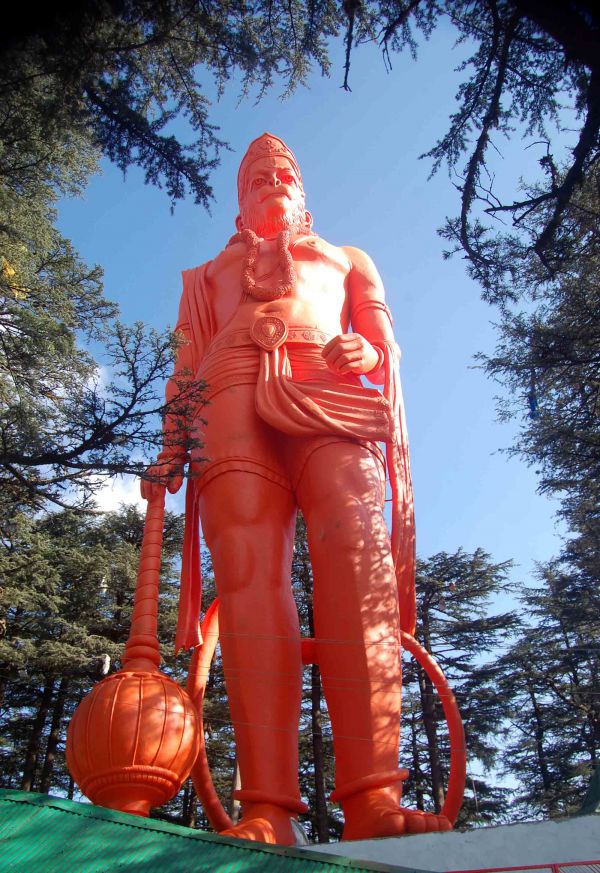 w
w
After walking down, I stood around waiting with a friend while my other companions went off to see another temple. As we stood there chatting, all of a sudden I felt something hit my head and my glasses disappear. My friend, in splits of laughter told me that I’d just had a monkey creep up behind me, eye my glasses closely, leap towards me snatching my glasses off my face.
I turned and sure enough, he had my glasses perched on an arch about 12 feet high. In vain I stood there trying to figure out how to get my glasses back. He, smart man that he is, walked across to the men who worked there and asked how I should get my glasses back.
These men had stopped me in the beginning of my walk up the temple telling me to take an offering for the monkeys. I, seasoned traveler that I am, ignored them. Then when this seasoned traveler was squinting at the monkey who had my glasses in confusion they offered me a way out.
The man took two packets of some sort of candy- small round sugar balls basically, and walked up the stairs to the monkey. As he rose, he split one open and threw it in all directions. A horde of monkeys descended on it scrabbling and fighting for the candy. Not the thief though- he wasn’t going to be swayed by a communal offering. As soon as the man got close to him, he threw him the other candy packet. The monkey caught that packed in one hand and neatly dropped the glasses- luckily into the vendor’s waiting hands.
Later on, we realized those monkeys were likely trained to retrieve people’s valuables in exchange for candy- a supposition our hotel manager confirmed while in splits of laughter at my predicament.
So, that’s the story of how I got some tender loving care from a monkey.
13 Friday Jul 2012
Posted in Travel
Tags
aviation, Flights, inclement weather, Law, transportation, Travel
So, this post isn’t about me directly. It’s about my classmate who was doing a project with me here in India, and her lovely travel situation from my perspective.
The flight she was taking from the city we were working in to Delhi was the first one in the morning, getting her there with well over 3.5 hours to her international flight. Perfect.
Except, an hour after we dropped her off in the airport, her flight had gotten cancelled. The reason? Inclement weather. I heard that and looked quizzically at the sky. The reason for my amazement was that there wasn’t a single cloud in the sky despite it being monsoon season. Yet, apparently in the 400 kms between the two cities there was some sort of inclement weather that grounded only that carrier’s planes.
Then began the rush of trying to find her an alternative. She managed to get a seat on the next available flight out, but missed her international flight.
Now by all accounts, she did nothing wrong. The missed international flight was due to the cancelled local flight, not her own doing. The international carrier, rather fairly, refused to pay any of the associated fees since it wasn’t their fault. The local flight operated by a large, well renowned international carrier refused too. But for no good reason. They just refused, saying that was a risk the customer took. Consequently, she ended up having to pay for a hotel room and the change fees in Delhi.
Thankfully, she got home safe. But, the fact remains that the airline which caused the fault isn’t culpable in India for any of the resulting issues.
To my knowledge, since I’ve had the pleasant experience of being bumped a few times, most airlines in the continental US will cover the situation above. However, according to the law, (http://www.usa.gov/topics/travel/air/resolve-problems/flight.shtml) they are not required to. Most European Airlines are required to compensate for delayed or cancelled flights, but weather is an exception (http://www.independenttraveler.com/travel-tips/air-travel/passenger-rights).
As someone who’s doing the same trip in a month, I’m now scrambling for options. Having derided travel insurance as unnecessary, I’m looking into it now, as well as credit card protection for travel issues.
I do believe that this is something that needs to be addressed in one form or the other for passengers- at the very least to add clarity to the situation, even if nothing per se is changed.
Any thoughts?
09 Monday Jul 2012
Posted in Medicine
Tags
Ear, ear nose and throat, ENT, ent surgeon, health, Hospital, medicine, middle ear bone, nasal polyps, Nose, Surgery, Throat
So over the last few days, I started shadowing an ENT surgeon. At 8:30 AM (we got lost trying to find the Operating Theater) we met him in his operating room where he had already started the first surgery.
As an ENT surgeon, he was responsible for ear, nose and throat. However, he was more of a rhinolaryngologist- he focused on the nose and the larynx. His surgeries that day, back to back reflected that. He started by removing nasal polyps- an unsatisfying surgery he said since they often return. Almost all his procedures were done endoscopically with a great deal of precision and speed. He often finished a *(more minor) surgery within forty minutes or an hour. As time progressed, we saw him remove a tubercular abscess from the vocal cords, a very finnicky looking surgery which would likely completely repair a man’s voice. We also saw him help reconstruct an ear with a missing incus (middle ear bone) which he fashioned from a piece of cartilage harvested from an earlier patient as well as a damaged eardrum from the fascia of the temporalis muscle.
We observed him doing over six surgeries in a little over six hours. It was amazing to watch and I’m going back soon!
04 Wednesday Jul 2012
Posted in Medicine
So a few days ago there was a patient who’d come into the out patient department to see the orthopedist we’d been shadowing. She was a follow up patient, who as soon as she walked in repeated her complaint. Let me give you an idea of how it sounded.
“You should do surgery”
“What surgery?”
“My knee hurts.”
“So should I replace it?”
“Well, I cant walk”
“That doesn’t mean I should do surgery”
“Well, why can’t I walk?”
“Because you’re overweight…. Lose weight…”
That was the gist of the conversation. And then, the patient smiling sheepishly left.
It’s a conversation that I can’t imagine being repeated in a US hospital. It’s a conversation unique for being so blunt and requiring a certain relationship between patient and doctor that is present in India, but harder to find in the hospital.
Is that something you’d prefer to hear? Or do you prefer the system presently in place in the US.
 Sarab Sodhi