
• About
  • Academic Publications
  • Bioethics
  • Blog!
  • Columnist: In-Training
  • Narrative Medicine: Why I Write

Sarab Sodhi

~ My Life in Medicine

Sarab Sodhi

Tag Archives: Hospital

Emergency Medicine from the eyes of a novice

18 Sunday May 2014

Posted by Sarab Sodhi in Medicine

≈ 2 Comments

Tags

Doctor, Emergency Medicine, ER, health, Hospital, Medical School, Medical Specialty, medical student, medicine, What to expect in an ER


Having a week of my Emergency Medicine experience under my belt, I’m sure I totally qualify as a veteran.

With my novice eyes-here are some observations and thoughts.

1. ER Docs aren’t your family docs or internists: Just yesterday I saw a lady with a slightly elevated blood pressure who’d been sent in by her visiting nurse because she hadn’t taken her medicine and needed a checkup. Talking to the patient revealed that she needed to follow up with her PCP who she’d not been able to see in a few months, and the nurse had figured that the ER would do that for her. The thing is the ER is a place for emergency care. If you’re having a heart attack, a stroke, delivering your baby, got hit by a baseball bat you need the ER. If you need a checkup and the wait times are too long at your PCP then the ER isn’t the best place for you. Between the traumas, the people with heart attacks and strokes and all the rest you’re not going to get the care you need.

2. Emergency Medicine is based on treating or ruling out emergencies: If you’re entering your EM rotation your attending wants two things from you on the differential- the bad things that could kill you and what it probably is. They’re far more worried about your chest pain being a heart attack and ruling it out before they send you home, consequently what could likely be something benign like a strained muscle can be treated once we’re sure it’s not a heart attack.

3. Not every patient in the ED will have (or needs) a diagnosis: As gratifying as most physicians find it to get an answer they can hang their hats on, the ER is often not the place for it. You’d like to, in an ideal world, figure out what’s going on with a patient but realistically when there’s a 3.5 hour waiting and 40 patients outside in the waiting room with a couple of traumas rolling in and the guy in bed 4 actively seizing you prioritize. That ends up leaving some of the things that need to be worked up on an outpatient basis as just that- waiting to be worked up outpatient. The ER is an incredibly expensive place to receive medical care as is the hospital in general so ED physicians try to judiciously use resources.

4. Sometimes people will hate you: The ER is a busy place, and there are always people you’ll be admitting. Often when you’re admitting someone to a service the resident on staff may be flabbergasted that your history and details didn’t include a more detailed family, social or physical exam- and that’s fair from their perspective. The problem comes, from an ED perspective a lot of those questions and answers won’t change an initial management. Secondly, anyone who’s causing your already busy workload to increase is likely not going to be your favorite person. For that reason, you may have the odd consultant who doesn’t jump for joy each time you call. That’s okay though. As long as the patient ends up being cared for.

5. Emergency Medicine is heavily weighted towards management:  Something I learned the hard way in a simulation session is that EM is a heavy management specialty. The traditional paradigm is for one to get a history, do a physician, collect an assessment and make a plan. In EM- you start with a plan then you keep going. And you modify your plan as you go. It seems rather obvious but if someone is coming in with chest pain that could be a heart attack you don’t want to spend 30 minutes getting a history and physical while the guy is actively losing heart muscle. Obvious it may be- it’s often challenging to make the switch from sitting and talking before you’re touching the patient and doing things to them. That said- 1 week in I’m already beginning to talk to, examine and treat my patients simultaneously.


In case you were curious I’m going to go into EM. Aka:
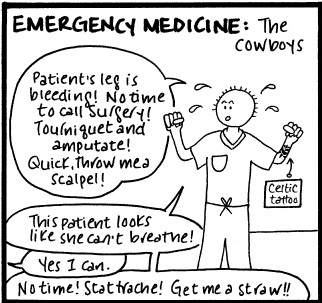
12 medical specialty stereotypes


A Labor of Love

07 Wednesday May 2014

Posted by Sarab Sodhi in Bioethics, Medicine, Philosophy, Writnig

≈ Leave a comment

Tags

Baby, Doctor, Hospital, Medical School, medical student, medicine, Obstetrics


I stood in the room, gowned and gloved, waiting for the woman to push. There was a thin trickle of sweat running down my back where the bright lights of the delivery room were trained. The baby was just short of the pubic bone, nearly ready to be born.

The mother-to-be had been pushing for hours and was exhausted. We watched the strips that recorded her and her baby’s heartbeats—each time that she pushed, her heart rate spiked to more than 170 beats/min and she closed her eyes and blew the air out of her lungs as we urged her on. “Push. Push. Push.” “Breathe. Breathe. Breathe.” We continued, our implacable rhythm timed to the clockwork contractions of her uterus.

Her exhaustion had caught up with her; I could read the defeat in her eyes as she whispered to her husband, “I can’t do it.” He smiled into her eyes and whispered back quietly, “Yes, you can.” My eyes were transfixed by this private moment between husband and wife, for all intents and purposes alone in a crowded delivery room, oblivious to the five other people standing around.

My hands moved on autopilot, assessing the baby’s position, a job my eyes should have done, as well. I stood there, doing what I was supposed to by habit—this was the fourth delivery that I’d done, after all, and I was a 5-week OB veteran. I stood there watching this moment, this beautiful, private moment, and some of life’s mysteries became clearer.

It was suddenly apparent to me how much I’d given up to be the one bringing this couple’s baby into the world. The fact that I could be welcomed into this intensely intimate moment and thanked after I’d done my job attested to the value of the profession I was joining. But in this moment, I wondered, at what cost?

This couple was a few years older than I. They had been married since they were my age and were having their first child now. They were madly in love, had jobs that fulfilled them, and were bringing their first child into the world.

At that moment, I had one purpose, one raison d’être, one thing I was searching for—that obsession, that passion, was medicine. In pursuit of it, I’d given up my hours, my sleep, my financial future, my social life, and my relationships.

My family was thousands of miles away, rarely seen and always missed. My friends were languishing, with unreturned phone calls and text messages on my phone, forgotten among 14-hour shifts and minutiae that needed to be memorized for each rotation. My love life was challenged by my constant lack of time and impossibly high standards—not to mention my jealous, unforgiving mistress named medicine.

She pushed again, and I snapped back to the here and now. Her son was crowning, and my hands moved automatically. I checked for a cord around his neck, pulling him out of his mother’s womb, one arm at a time. He was born from a warm and safe womb into the cold and lonely world he would now inhabit.

I swaddled him in blankets and placed him on his mother’s chest as his parents stared at him with love, drinking in the sight of his fingers, his toes, his perfect little features. I finished my work quietly. They thanked me warmly as I left the room and ripped off my gown and gloves as I went, their eyes never having left their beautiful baby boy.

I smiled as I left their delivery room, lost in my bittersweet thoughts. I kept walking because my shift had been done 20 minutes ago. I walked to a house filled with books about medicine and the tools necessary for its practice—stethoscope and white coat among them. I walked to an empty house and an empty bed. I was on again in 9 hours.

Ann Intern Med. 2014;160(9):653. doi:10.7326/M13-2673

The Things They Carried: An MS3 Story

24 Thursday Apr 2014

Posted by Sarab Sodhi in Medicine

≈ 1 Comment

Tags

Doctor, Hospital, Hospitals, Medical School, Medical Students, medicine, Step 1


Having just finished my third year here are the things that made my life easier.

1. Comfy shoes: Try walking around the hospital on rounds for >4 hours a day and standing in one place in a pair of uncomfortable dress shoes. I dare you. I can’t even imagine how it would be in heels. Buy yourself some comfy shoes for work. I use rockports when I need to be dressed nice and a good pair of sneakers for when I’m in scrubs. Invest in them- your feet will thank you.

2. UpToDate Mobile: You can signup for an uptodate username and password at any hospital computer and download the mobile app. If you’re not familiar with uptodate it’s the best way to quickly educate yourself about relatively recent guidelines, pathophys, treatment etc. Keep it on your cellphone so you can read whenever you get a second.

3. A stethoscope belt: Stethoscopes can be heavy. Wrapped around my neck it started making me stick my neck out like a turkey. Around Thanksgiving that’s a dangerous thing to look like. A stethoscope holder may not be the most fashionable thing around, but a few days in the hospital will make a sartorial slob out of any fashionista.

4. Snacks: Keep your white coat well stocked with snacks. You may prevent a hypoglycemic coma on Surgery, OB-GYN, and Medicine.

5. A gym membership: You need to stay sane in MS3- it’s busy and you’re going to need things out of medical school you can focus on. For me that was the gym. It was my endorphin rush, my cleanser and my calmer. Do what makes you happy dude.

6. Books: Walk around with the books you might need on your rotation. They’re specific so expect a post to follow later, but a good one year round especially around Step 2 time is USMLE Step 2 Secrets.

7. Reference Guides: Everyone suggests you buy the “Green Book” (used to be Red, now is purple). It’s the Pocket Medicine series and was questionably useful on medicine. Buy it if you’re really keen.

8. A credit card in your ID holder: Your stomach will thank you when you’re in the cafeteria with 10 minutes to eat between OR cases.

9. Pens: Black for the hospital- no blue. And keep your nicer pens on the inside. An attending or resident can snag a pen and “forget” to return it…

10. Fresh socks/Undies/Toothbrush: This one should be self explanatory- but post call- these are amazing.

11. Gum: If like me you’re prone to the sleepies especially after 4-5 back to back OR cases while sitting through a fascinating lecture on the biochemistry of transplant rejection- have gum in your pocket. Or your attending WILL make fun of you.

12. Someone to complain to: We complain. That’s what we do. We complain about our lives, the slights both real and imagined that we endure and the futility of our positions. You need someone to complain to- or lots of someones. So keep friends, significant others, classmates, parents, everyone handy. You’ll need them.

This will be one of the best and worst moments of your lives. My two months on IM was the most educational experience in all of medical school. The year will transform you from a bumbling and eager to please second year into a slightly jaded, somewhat educated, rather arrogant semi-physician.

In fact I’d postulate that the bulk of your learning pre-residency happens in this year. Buckle up. It’s going to be a fun (if slightly bumpy ride!)


Ode to an ENT surgeon

09 Monday Jul 2012

Posted by Sarab Sodhi in Medicine

≈ Leave a comment

Tags

Ear, ear nose and throat, ENT, ent surgeon, health, Hospital, medicine, middle ear bone, nasal polyps, Nose, Surgery, Throat


So over the last few days, I started shadowing an ENT surgeon. At 8:30 AM (we got lost trying to find the Operating Theater) we met him in his operating room where he had already started the first surgery.

As an ENT surgeon, he was responsible for ear, nose and throat. However, he was more of a rhinolaryngologist- he focused on the nose and the larynx. His surgeries that day, back to back reflected that. He started by removing nasal polyps- an unsatisfying surgery he said since they often return. Almost all his procedures were done endoscopically with a great deal of precision and speed. He often finished a *(more minor) surgery within forty minutes or an hour. As time progressed, we saw him remove a tubercular abscess from the vocal cords, a very finnicky looking surgery which would likely completely repair a man’s voice. We also saw him help reconstruct an ear with a missing incus (middle ear bone) which he fashioned from a piece of cartilage harvested from an earlier patient as well as a damaged eardrum from the fascia of the temporalis muscle.

We observed him doing over six surgeries in a little over six hours. It was amazing to watch and I’m going back soon!

How to Deal with Pharmaceutical Reps

03 Tuesday Jul 2012

Posted by Sarab Sodhi in Medicine

≈ Leave a comment

Tags

Drug Reps, Hospital, medicine, Pharmaceutical


I recently discovered, courtesy of one of the doctors I’ve been working with here in India a brilliant way of dealing with pharmaceutical representatives. Let me lay it out for you.

In an outpatient department where one is supposed to see about 25 patients in a little over an hour, as patients crowd into the doctors room surrounding him from all sides the doctor has pharmaceutical reps push their way through. As they approach the table, they place some sort of literature, cards, pamphlets etc. on the already crowded desk and begin to whisper in his ear. As soon as this happens, the doctor closes his eyes. Once, a pharma rep asked why he did that. His response, not bereft of sarcasm was that he was closing his eyes to better focus on what the rep was saying.

He listens usually nodding along, and bids the pharmaceutical rep goodbye. As the rep leaves, he balls up the materials and throws it over his shoulder, or sweeps it to the floor. Now I know what you’re thinking- littering is just terrible. But, I quite like the way he chooses to deal with these reps.

He refuses to be nudged in one direction or another, treating his patients in the way he knows best at minimal cost to them while providing maximal benefits.

How would you like to deal with a pharma rep? Or do you think the way this doctor functions is wrong?

Indian Hospitals: Public and Private

26 Tuesday Jun 2012

Posted by Sarab Sodhi in Uncategorized

≈ 1 Comment

Tags

Healthcare, Hospital, India, Private, Public


So, as you all know I’ve been shadowing at an Indian government hospital for the last few weeks. Recently, I ended up going to an uber expensive, uber nice private hospital with my grandparents. Now, a few words on the differences.


Firstly, the government hospitals. The doctors there are excellent- well trained (not by the training, as much as the practice of seeing that huge patient load), they function with minimal resources and use novel solutions and approaches. They offer excellent treatment options, try to minimize risks to the patient and generally do what’s right. They don’t sugarcoat a patient’s prognosis, nor do they mince words. I’ve heard them tell patients with regards to a degenerative disease “baal safed hoten hain, na, voh safed hote rahenge- hum dhere kar sakte hain, rok nahi sakte” namely, as your hair gets white when you age, it keeps getting whiter, right? We can’t stop your hair (disease) from getting whiter (worse), but we can slow it down.

The downside to a government hospital- the crowding. Treatment is uber cheap, but due to the sheer patient load, you hit delays after delays and are more likely to die of an infection than of the treatment’s risks. Also, a lot of the patients who come in are being seen after days- precious days which if treatment were instituted earlier could have had a different outcome.


Private hospitals on the other hand, have no problem with overcrowding. Doctors have time for you, they’re soft, polite, soothing and charming. They’re understanding of your concerns and are willing to change your treatment based on what your limitations are. The flip side is, from what I’ve heard from physicians on staff, they are quite willing to “order” surgeries for patients who don’t really need it, to make their required bottom lines. The upside is, they’re shining clean, the staff is typically quite nice and fairly competent. Your chances of dying from infection are rather slim, however the general idiotic actions in medicine, are quite common there. One of the things I’ve heard from a patient at one of India’s best private hospitals, is that after a blood sample was taken and analyzed, the remainder of the blood was (with some air) injected back into his veins. As he put it, he sat there waiting for the pulmonary embolus that would kill him. Thankfully, that didn’t happen.


If you ask me, where I would go- I’d say I’d go to a government hospital for a surgery or a consult, but not to be admitted- for that I’d choose a private hospital.

30 seconds to Diagnose

21 Thursday Jun 2012

Posted by Sarab Sodhi in Medicine

≈ 2 Comments

Tags

health, Hospital, India, medicine


Today we observed a day in the Outpatient Department of the Orthopaedic Clinic at the hospital I’ve been observing at. To give you an idea of the day, let’s start with this. 10 or 12 doctors saw over 250 patients in a little over an hour and a half.

Yes, that was 10 doctors and 250 patients. Yeah, that means they saw 25 patients each. In one and a half hours. Which means each doctor saw 16 patients an hour. Each patient got 3.75 minutes. Which seems higher than what we observed.

To paint the scene for you, we were sitting in the doctors office, in two chairs facing a eminent ortho surgeon. He was sitting in one chair, and the chair next to him was for the patient. Patient’s treatment cards were dropped off, and he called them in the order of the cards arrival. (Speaking of the cards, they cap patients at 250 per OutPatient Day- the first 250 get cards and subsequent treatment). So, the doctor would call out a name-  said patient would come in, and they’d sit down, by which time the doctor had asked them what the problem was. As the patient spoke, the doctor would be looking at their X-rays, CT scans, or MRI’s. Then, as they went along, the doctor would do a quick physical exam, without asking the patient to disrobe, scribbling in the card the whole time, tell the patient the treatment or tests required and send them off. Then, the next patient and so on. As time went along, the room got more crowded as patients started waiting within, other doctors would pop in for consults and more patients would be standing around while the patient being seen was being questioned about their ailments.

How different from the ideal patient encounters we’re taught in medical school. Forming a bond with your patient, open ended questions, exposing an area for a physical exam, vital signs, not to mention washing one’s hands all went out the window. The doctors worked like automatons, seeing patients one after another, sorting, treating, prescribing and diagnosing.

As it went along, we saw things we’d never heard of in the US. Skeletal Fluorosis, and Osteoarthritic Tuberculosis. Patients who had TB in their L3-L4 vertebrae, and patients who’s teeth and fallen out and bones were brittle due to excessive Fluoride. It was astounding, and though the doctor was swept off his feet, in minutes snatched between patients, or while the patient was sitting there we’d learn about these diseases and unique presentations of others.

I saw the benefits of the paternalistic model of physician-patient relationships once again. Patients who’d religiously follow the doctors lifestyle prescriptions. Anything they said, from exercise, to stop eating this, stop doing that, was met with a Ji, Doctor Sa’ab (Yes, doctor). The doctors would say, quite clearly, “This problem you’re having is due to your weight. Lose weight.” and the family would follow their orders to the letter.

Part of me considers that perhaps we should move back to a paternalist model of medicine, where the doctor knows best- you’ll solve the problem of non compliance. But, at the same time, doctors aren’t equipped to make a value judgement based on their patients lives. The only one who can do that is the patient. If I were enough of an idealist, I’d imagine that a perfect blend of the two exists to have neither’s drawbacks and both’s positives. I share no such hope- I just realize that some systems work in certain places and others work well in different places. It’s all about the culture and society you set it up in.

Thoughts?

Match Day

Match Day 2015March 20, 2015
The day my future is revealed

Blog at WordPress.com.

Privacy & Cookies: This site uses cookies. By continuing to use this website, you agree to their use.
To find out more, including how to control cookies, see here: Cookie Policy
  • Subscribe Subscribed
    • Sarab Sodhi
    • Join 51 other subscribers
    • Already have a WordPress.com account? Log in now.
    • Sarab Sodhi
    • Subscribe Subscribed
    • Sign up
    • Log in
    • Report this content
    • View site in Reader
    • Manage subscriptions
    • Collapse this bar
 

Loading Comments...